Do token log-probabilities reveal when debating LLM agents reason badly?
Multi-agent debate systems are usually judged only on whether the final answer is right. The intermediate reasoning is rarely measured, and an agent can argue confidently and still be wrong. In this series of first-authored papers with Justin Cheok, Jacob Horne and Mark Warschauer, I study whether a model’s own token-level confidence (the log-probabilities of its reasoning tokens) predicts reasoning quality as scored by an LLM judge, and whether either signal tracks task correctness.
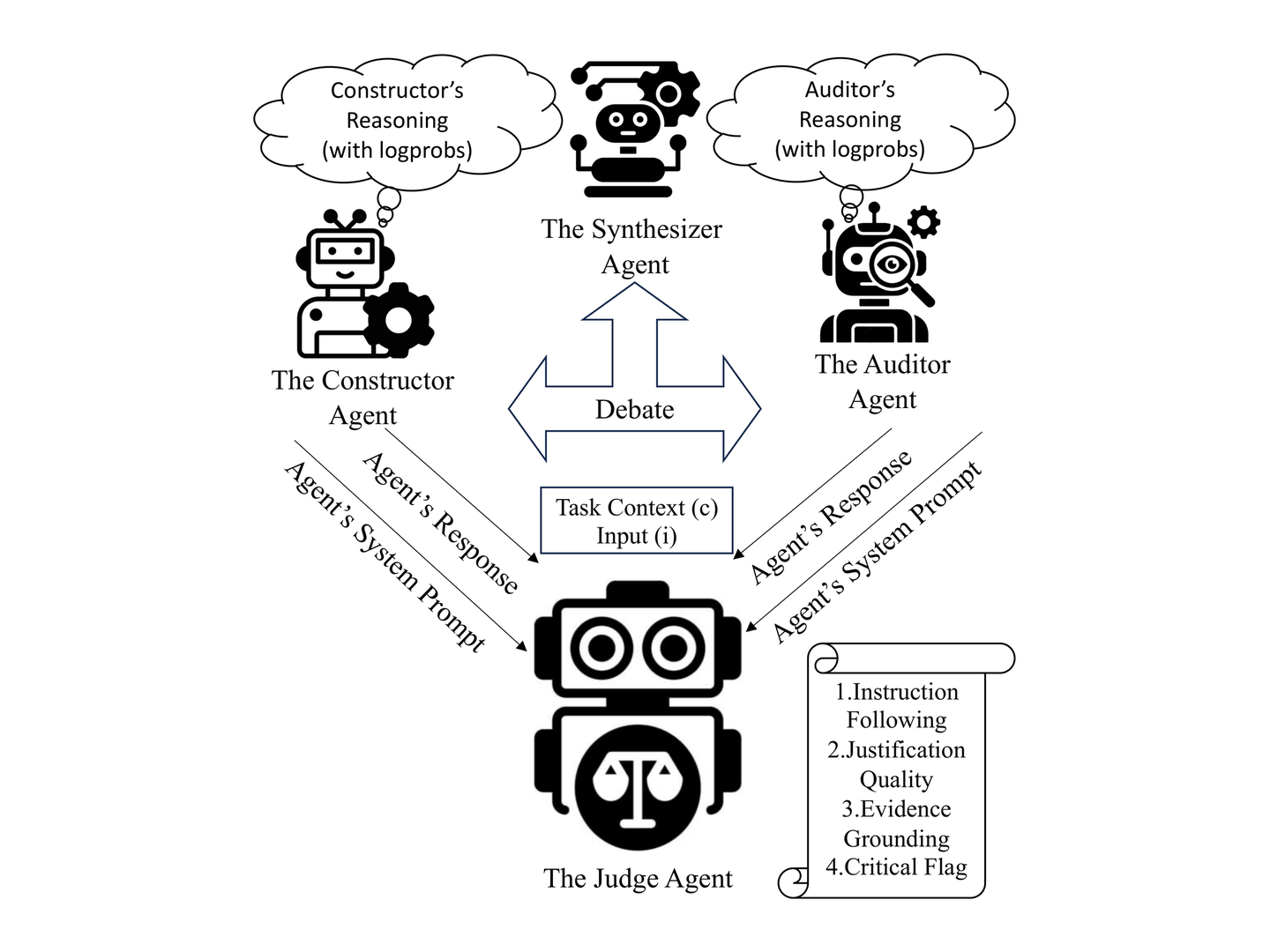
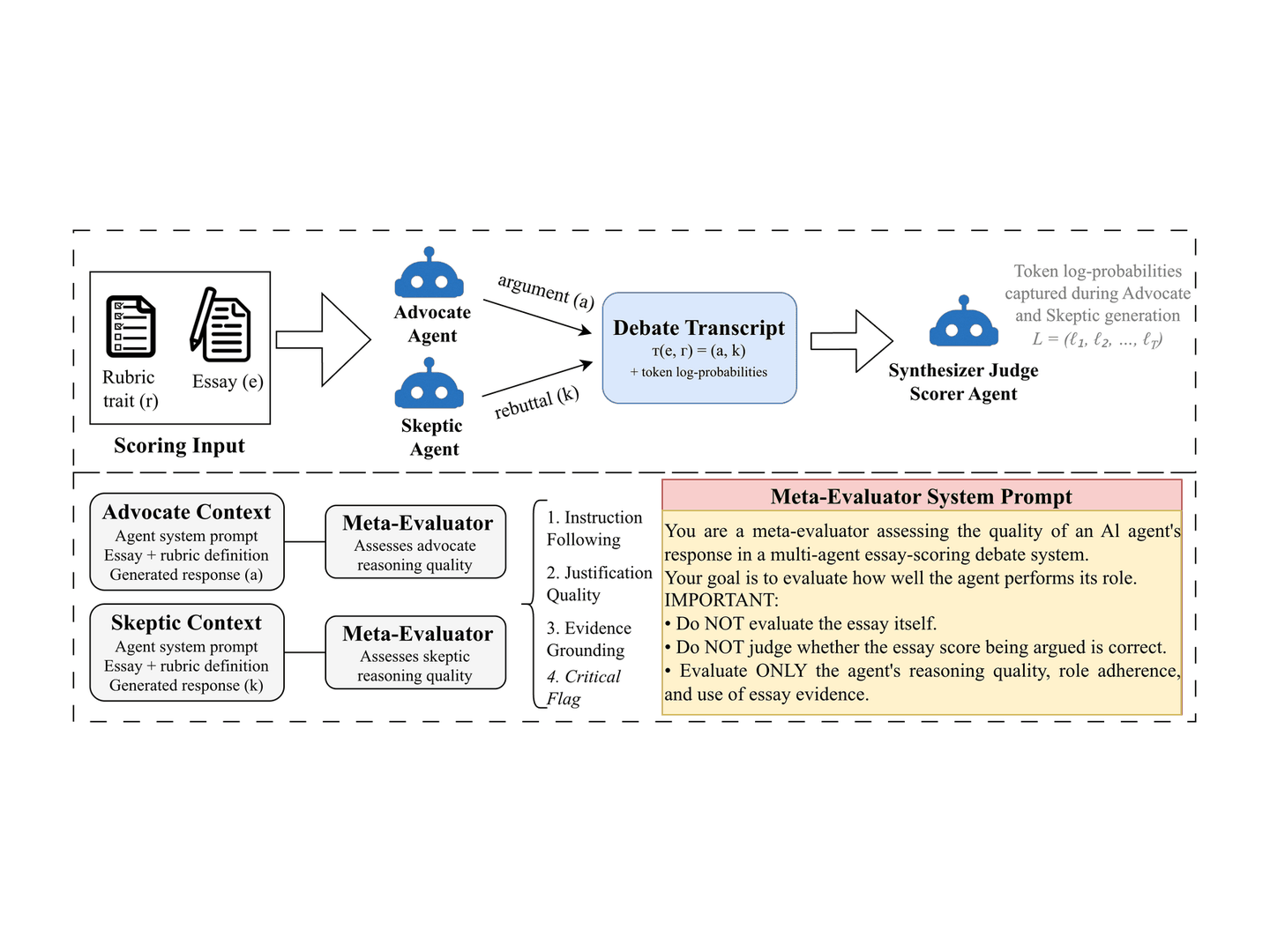
The framework pairs a two-agent debate (a Constructor that builds a case and an Auditor that challenges it; Advocate and Skeptic in the essay-scoring setting) with an LLM-as-judge that scores each agent’s reasoning for instruction following, justification quality and evidence grounding, and raises a critical-failure flag when the reasoning breaks down.
Findings so far, in rubric-based essay scoring on two ASAP essay sets:
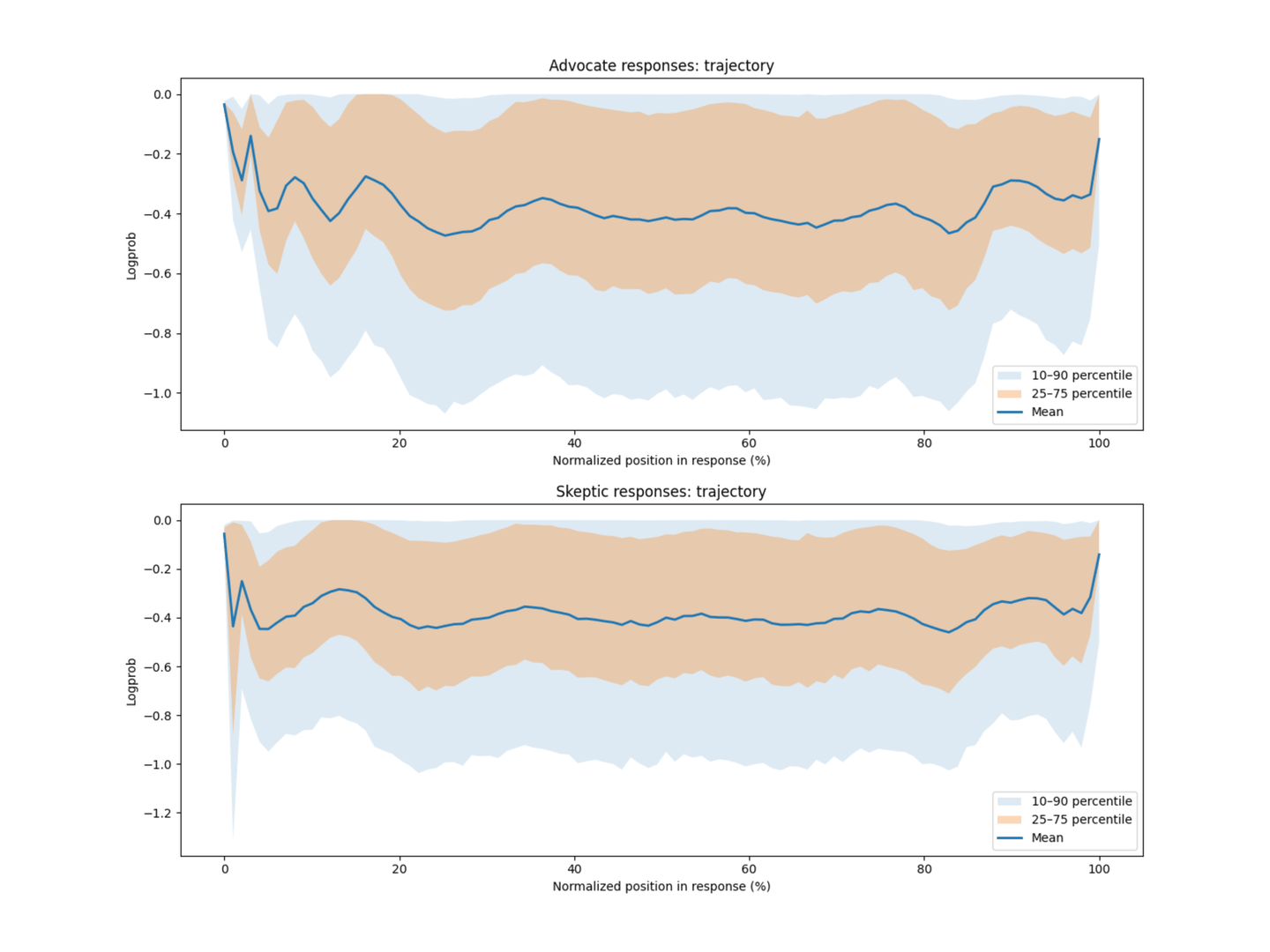
Confidence follows a consistent four-phase trajectory over the course of a response, and the two agent roles behave differently: confidence aligns with judged reasoning quality roughly twice as strongly for the Constructor as for the Auditor, and confidence-based detection of critical reasoning failures is markedly more reliable for the Constructor (AUROC 0.804) than for the Auditor (0.634) (Keramati et al., 2026).
Confidence over the first few generated tokens is consistently the strongest predictor of judged reasoning quality, outperforming full-sequence statistics; the opening segment of a response is the most heterogeneous and therefore the most informative region (Keramati et al., 2026). An earlier version of this analysis appeared as a poster at the ICLR 2026 Workshop on Logical Reasoning of Large Language Models (Keramati et al., 2026).
The practical goal is a cheap monitoring layer for multi-agent scoring systems: a signal that is available at decoding time, costs no extra model call, and tells a system when a judge should look more closely.
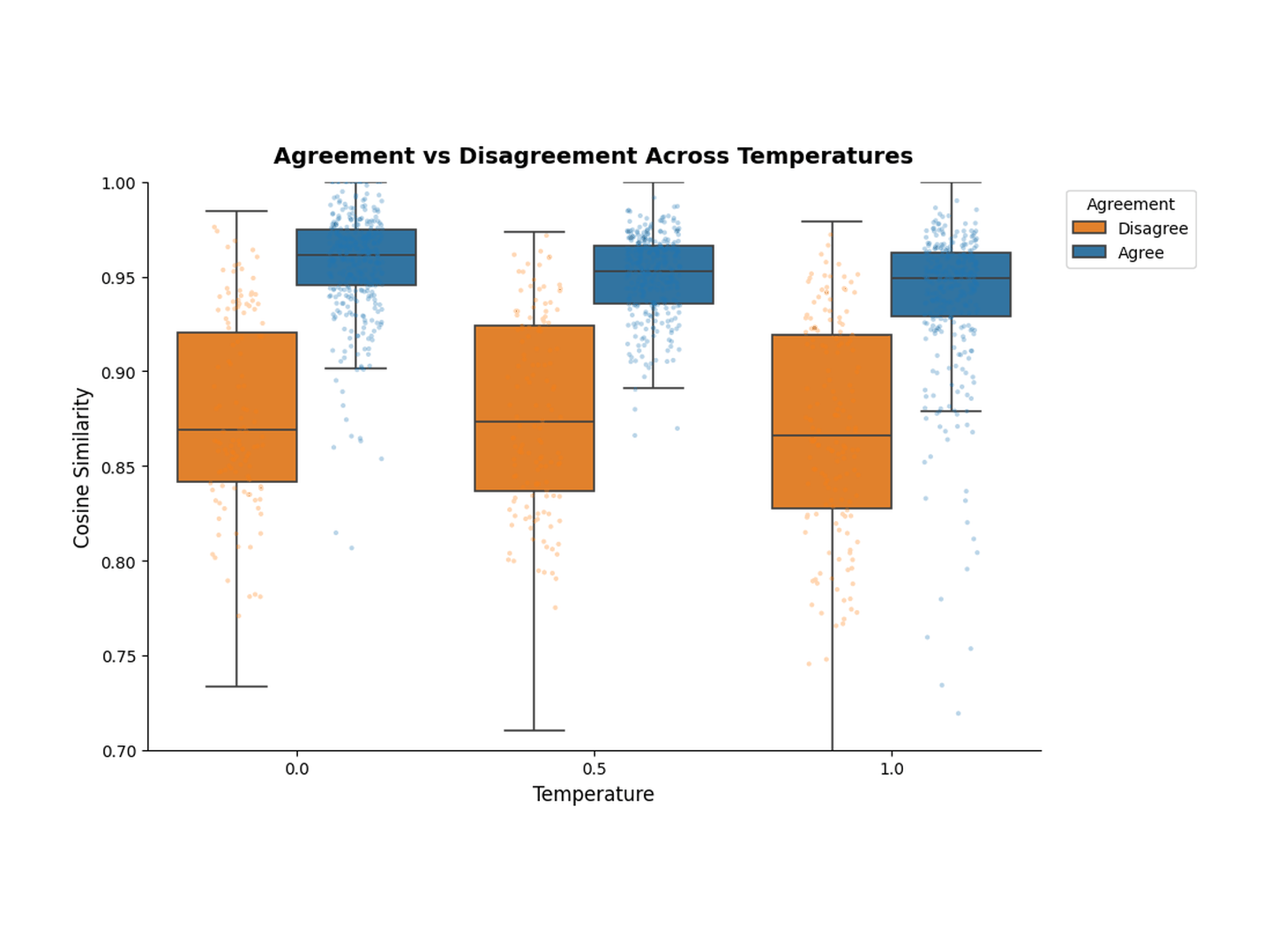
In related work, I contributed to a LAK 2026 study that treats disagreement between LLM agents’ reasoning traces as an analytic signal for qualitative coding in learning analytics (Tajik et al., 2026).
Mean token-level confidence of the Constructor and Auditor agents across a response. The volatile opening tokens carry most of the signal about reasoning quality (figure from the ACL 2026 SRW paper).
Diagnoses failure modes in multi-agent debate systems by combining token-level log-probability signals with LLM-as-judge evaluation. The work shows how confidence calibration can surface cases where agents are confidently wrong, improving the reliability of multi-agent reasoning for evaluation tasks.
@inproceedings{keramati2026confidentliar,title={The Confident Liar: Diagnosing Multi-Agent Debate with Log-Probabilities and {LLM}-as-Judge},author={Keramati, Ali and Cheok, Justin and Horne, Jacob and Warschauer, Mark},booktitle={Proceedings of the 64th Annual Meeting of the Association for Computational Linguistics (Volume 4: Student Research Workshop)},pages={1361--1375},year={2026},month=jul,publisher={Association for Computational Linguistics},doi={10.18653/v1/2026.acl-srw.121},}
Evaluating reasoning quality in multi-agent LLM systems is challenging, especially for open-ended tasks without reference answers. We investigate whether intrinsic confidence signals, token-level log-probabilities from decoding, can predict reasoning quality as assessed by LLM-as-judge evaluation. Using a debate-based essay scoring framework, we compare confidence proxies against rubric-based judge scores across two ASAP essay sets. We find that early-token confidence, particularly within the first few generated tokens, is consistently the strongest predictor of reasoning quality, outperforming full-sequence statistics. Analysis of log-probability trajectories shows that the opening phase of generation is the most heterogeneous and therefore most informative. We also observe a systematic asymmetry between agent roles, with stronger alignment between confidence and quality for supportive reasoning than for adversarial critique. These results suggest that early decoding dynamics provide a lightweight and effective signal for estimating reasoning reliability in multi-agent LLM systems.
@inproceedings{keramati2026earlytoken,title={Early-Token Confidence Predicts Reasoning Quality in Multi-Agent {LLM} Debate},author={Keramati, Ali and Cheok, Justin and Horne, Jacob and Warschauer, Mark},booktitle={Proceedings of the Fifth Workshop on Generation, Evaluation and Metrics (GEM)},pages={653--667},year={2026},month=jul,publisher={Association for Computational Linguistics},doi={10.18653/v1/2026.gem-main.60},}
Examines whether early token-level confidence signals can predict the reasoning quality of large language models in multi-agent debate systems. The findings show that signals from the first few generated tokens are especially informative for estimating reasoning reliability, offering a lightweight way to monitor and evaluate multi-agent LLM performance.
@inproceedings{keramati2026firsttokens,title={The First Tokens Matter: Early Confidence Signals for Evaluating {LLM} Reasoning},author={Keramati, Ali and Cheok, Justin and Horne, Jacob and Warschauer, Mark},booktitle={ICLR 2026 Workshop on Logical Reasoning of Large Language Models},year={2026},month=apr,}
Proposes a new way to analyze large language model reasoning traces in multi-agent systems by treating disagreement as a meaningful analytic signal. The work shows how semantic similarity between agent reasoning can help detect coding ambiguity, improve qualitative analysis workflows, and strengthen human–AI collaboration in educational research.
@inproceedings{tajik2026disagreement,title={Disagreement as Data: Reasoning Trace Analytics in Multi-Agent Systems},author={Tajik, Elham and Borchers, Conrad and Shahrokhian, Bahar and Simon, Sebastian and Keramati, Ali and Pal, Sonika and Sankaranarayanan, Sreecharan},booktitle={Proceedings of the 16th International Learning Analytics and Knowledge Conference (LAK26)},pages={933--939},year={2026},month=apr,publisher={ACM},doi={10.1145/3785022.3785101},}