AI framework for personalized learning at scale
Learner modeling, activity suggestions and facilitator support for low-cost quality education.
Access to quality education is unequal between and within countries, and socioeconomic barriers together with a fast-changing job market make the gap wider. In the Cognitive Systems Lab at the University of Tehran (2023–2024), led by Majid Nili Ahmadabadi, I contributed to a framework for AI-powered digital learning environments that aim to deliver quality education at scale and at low cost (VatandoustMohammadieh et al., 2024).
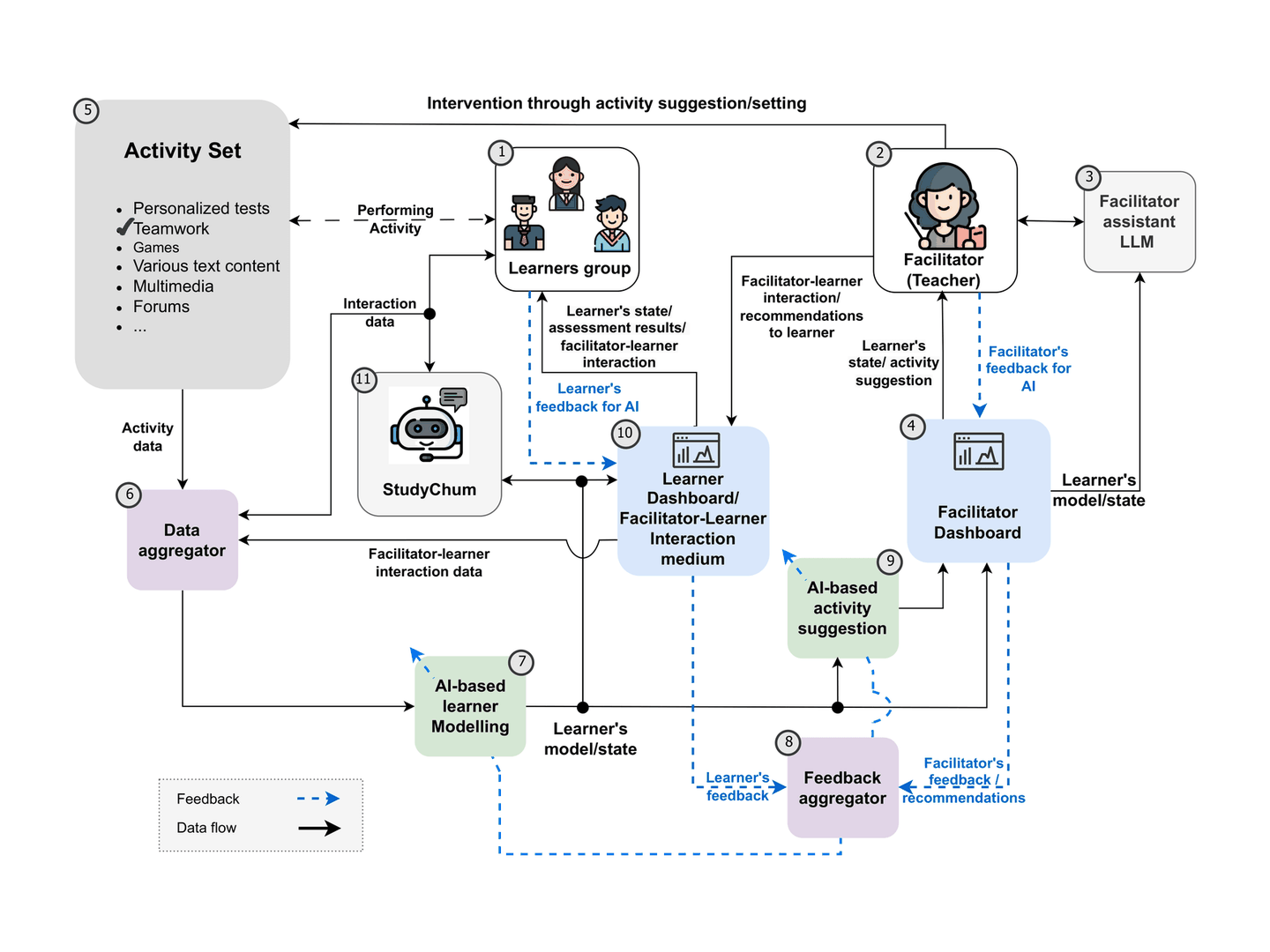
The framework is grounded in Deep Learning theory in the educational sense of the term: learners act with agency, and teachers become facilitators, which is what makes the approach suitable for large cohorts. The paper derives eight design principles from the learning sciences and from AI, and lays out an architecture in which groups of learners work on a set of activities (personalized tests, teamwork, text, games, multimedia, forums) while three AI components support them: learner modeling based on Open Learner Modeling, in which learners can see and respond to the model the system holds of them; AI-based activity suggestions that use that model to recommend what to do next; and AI assistance for facilitators through dashboards and a facilitator-assistant LLM. Feedback from learners and facilitators flows back into the models.
My work in the lab was on the learner-modeling and recommendation side: a chatbot for open learner modeling that updates a learner’s profile from conversation and suggests activities, and a prototype learning management system that integrated ChatGPT with Google Classroom. The paper (arXiv, 2024, with Marzieh Vatandoust Mohammadieh and Mohammad Mahdi Mohajeri) presents the framework and its principles rather than a deployment study.
Links: Preprint (arXiv 2412.04483)